What to type
A method for every reply — brief, informative, friendly, firm — and fifteen word-for-word scripts for the messages you keep getting.
Being reasonable is not working. You need a system: what to type when the message is cruel, what to write down afterwards, and when to stop managing it yourself.

At six the other car is not there. At ten past, your phone lights up.
The message is long. It says you "forgot" to send the inhaler last weekend, which is not true, because you sent it in the front pocket and you photographed it. It says the school called about the field trip form and you "as usual" did nothing. It says if you want to play games about the holiday schedule, the lawyer is ready. It ends with a question about the dentist, buried at the bottom, that actually needs an answer.
You start typing. … It is four paragraphs long. Every sentence in it is true, and every sentence in it is a handle for the next fight.
This is the moment the book is for.
A method for every reply — brief, informative, friendly, firm — and fifteen word-for-word scripts for the messages you keep getting.
An exchange log and an incident log, kept the flat, factual way that shows a pattern instead of a grudge.
Six clear lines that turn a messaging problem into a legal one — and where to find help when money is tight.
Eight replies from the toolkit's Reply Script Card, word for word. Find the closest one, change the details, keep the length.
BIFF® is a registered trademark of the High Conflict Institute, which created the method. The toolkit summarizes it and is not affiliated with or endorsed by the Institute. Scripts are examples, not legal advice.
Sort each message into one of three piles before you do anything. The third pile is usually the largest.
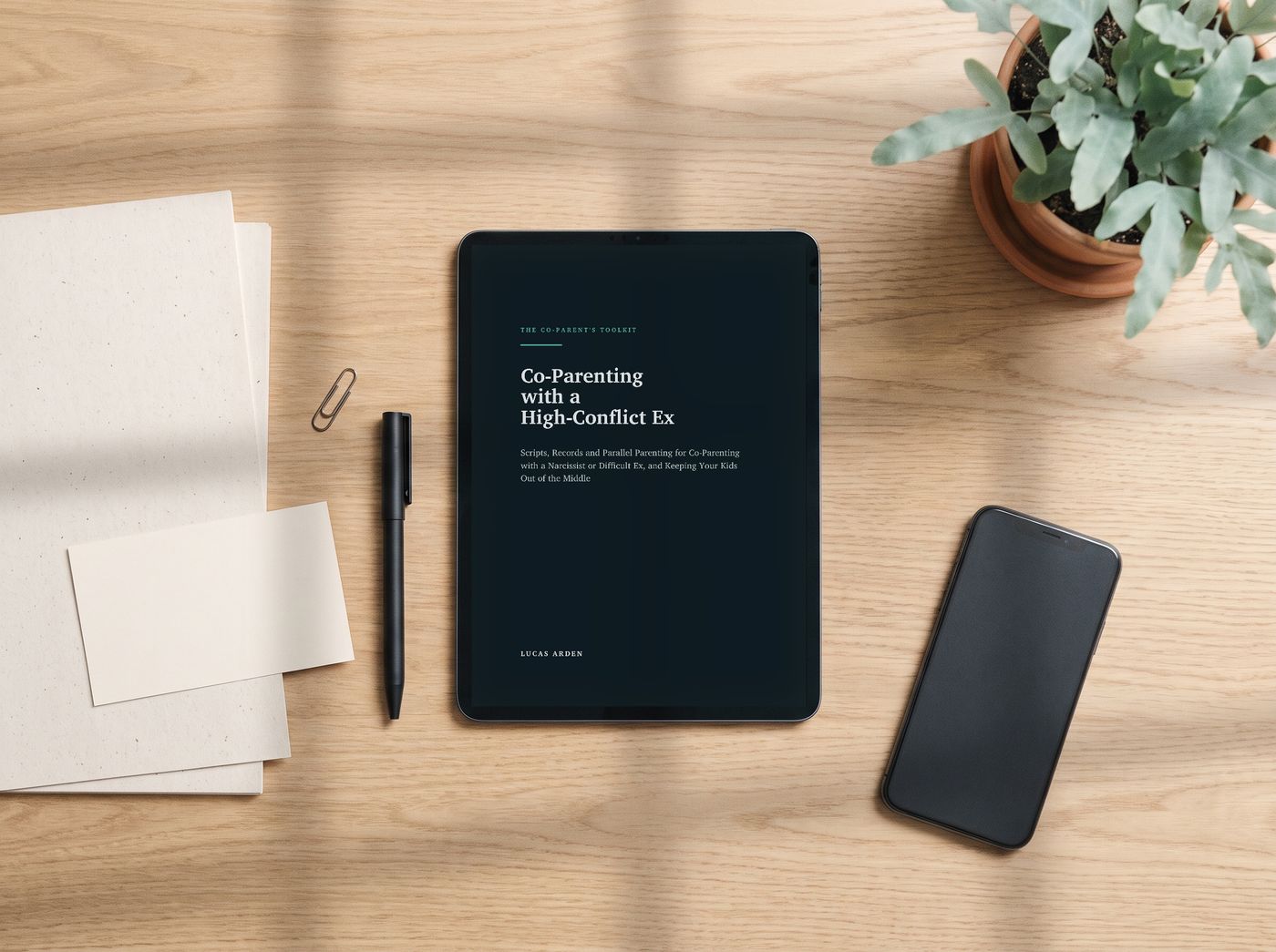
Seven chapters: telling high conflict from something more dangerous, using your order as the rulebook, replies that don't add fuel, parallel parenting, keeping records, keeping the children out of the middle, and when to bring in professionals.
Printable logs plus a spreadsheet version of both. One line for every handover — the smooth ones too — and a separate log for anything out of the ordinary.
Two pages to keep by your phone: how to build any reply, the three piles, and eight scripts for the messages you keep getting.
One-paragraph rules for the moments you can't think straight — when to answer, what to log, when to stop and call.
Custody rules are set state by state. Instead of printing someone else's, the guide shows you where your state publishes its own.
Where to find legal aid and low-cost help, and what mediators, guardians ad litem and parenting coordinators actually do.
This toolkit is for a difficult co-parent, not a dangerous one. If you are afraid of the other parent — if you have been threatened, hit, followed or watched, or you change what you do because of what they might do — brief, polite messages will not fix it. Talk to someone trained for it first.
The guide's first chapter covers this in full, including safety planning and the 988 Suicide & Crisis Lifeline.

It doesn't diagnose your ex — that isn't your job, or the book's. It isn't legal advice and has no fill-in legal documents. It doesn't print one state's rules as if they were yours. It gives you a method, and it tells you when the method stops being enough.
$49 one-time · instant download
Secure checkout · instant download link by email
30-day money-back guarantee — no questions asked
Lucas Arden Guides are sequence-first handbooks: what to do, in what order, in what words, and where to find the answer that's current for you. They're built to be used at a kitchen table, not studied.
How this guide was made. AI was used as a tool to research and draft it. Every figure, rule and quoted requirement was checked against the source listed in its notes, on the date shown there, and anything that varies by state is marked. The structure, the review and the final approval were done by a person.
No. It's general information and a method for communicating, keeping records and knowing when to get help. It isn't legal, psychological or medical advice, and it tells you plainly when a situation needs a family-law attorney or legal aid.
It's written for parents anywhere in the US. Custody rules are set state by state, so the guide doesn't print one state's rules as yours — it shows you how to read your own order and where your state publishes its rules.
Not first. If there is violence, threats, stalking or fear, contact the National Domestic Violence Hotline (1-800-799-7233, or text START to 88788) or local emergency services before using any of this. Several tools in the book assume two parents on roughly equal footing.
No. Parallel parenting — one of the book's chapters — is built for parents who can't cooperate: separate households, minimal contact, and clear rules for handovers, schools and doctors.
No. The guide explains how to move communication into writing, what to do if your order names a channel, and how to propose one app without starting another fight.
Email within 30 days and you'll get a full refund — no questions, no need to explain. Refund details.
An instant download: the guide as a PDF, the exchange and incident logs as a printable PDF and a spreadsheet, and the two-page Reply Script Card. No account or subscription required.

You with a phone in your hand, deciding what kind of evening this is going to be.
Get the toolkit — $49