What order
Twelve parts, each covering a window of time. Within each window the tasks are ranked — do the top three in each and the estate still gets settled correctly.
You've just been made responsible for settling someone's estate. A checklist tells you what. This tells you what order, what to say on the phone, and when to stop and hire someone.
“While the advice can't be overly specific because of differing state laws, the checklist and steps are sound. It gives general deadlines and the order of events everybody needs to know to navigate through probate.”
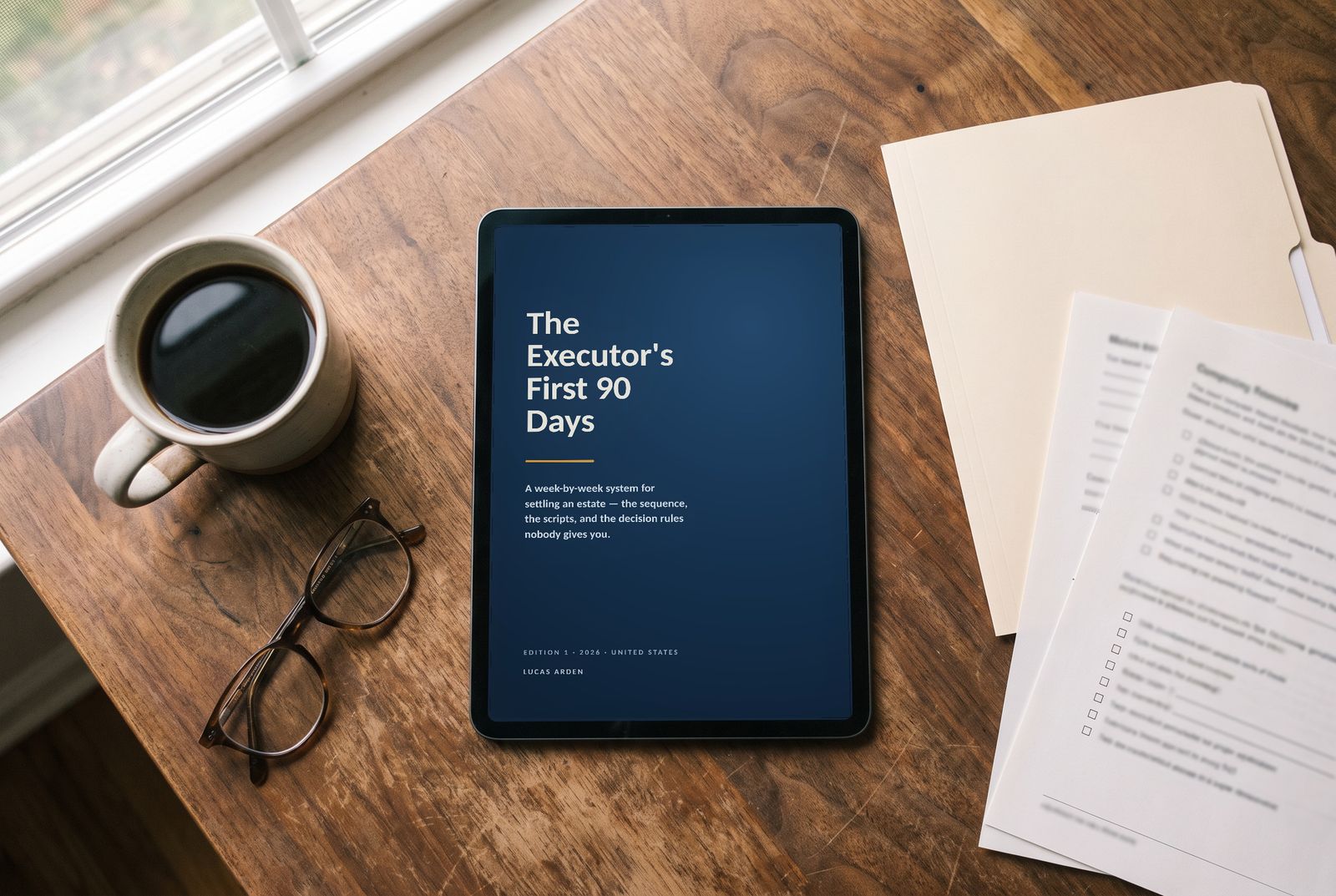
Most people in your position get handed a long list of tasks. What actually decides whether an estate settles cleanly or expensively is the order you do them in — and almost nobody tells you that.
Twelve parts, each covering a window of time. Within each window the tasks are ranked — do the top three in each and the estate still gets settled correctly.
Ten verbatim scripts — the bank, Social Security, the life insurer, the mortgage servicer, the probate clerk, the debt collector, and the sibling who wants their money now.
Decision rules, not vibes, for when an hour of a lawyer's or CPA's time is worth it. The estate pays for it, and it's cheap next to the mistakes it prevents.
Almost nothing is urgent. Four things matter in the first 48 hours; everything else waits comfortably. Here's a taste of how the guide lays it out.
If everything else falls out of your head, keep these. They're straight from the guide's opening — yours whether you buy it or not.

Twelve parts organized by when — the first 48 hours, days 3–14, weeks 2–6, days 60–90 — with the tasks in each window ranked, so you always know what to do first.
A 12-tab working spreadsheet with 146 built-in formulas: inventory, debts, expenses, distributions, household accounts, the call log, an executor-hours log and a printable accounting summary for beneficiaries. It warns you if the estate may be insolvent and counts down to every key date. Opens in Excel, Google Sheets or Numbers.
The First 48 Hours — a short printable list for the days you can't absorb a book. And the Master 90-Day — every task in order, cross-referenced to the guide.
A credit-bureau deceased alert, a creditor notice, a life-insurance claim cover letter, and a monthly status letter for beneficiaries — plus how to get a proper receipt and release.
For each of the 24 answers that depend on your state: what it's called, and where your state publishes the current answer for free.
Probate, Letters Testamentary, EIN, successor in interest — in plain English, defined the first time you meet them.
Three of the ten scripts, exactly as they appear in Part 11. Fill in the details and they fill themselves in. Then copy and use them.
Nothing you type leaves this page.

It prints no state-specific dollar figures. Those are set by your state, change on their own schedule, and are published free by the state itself. So the guide teaches you the sequence and shows you exactly where to look — the part that doesn't expire.
⚠ Check your state appears about twenty times. That isn't a hedge. It's the actual shape of the job.
$49 one-time · instant download
Secure checkout · instant download link by email
30-day money-back guarantee — no questions asked
Lucas Arden Guides are sequence-first handbooks: what to do, in what order, in what words, and where to find the answer that's current for you. They're built to be used at a kitchen table, not studied.
How this guide was made. AI was used as a tool to help author it. Every federal claim was checked against primary sources — the IRS, the Social Security Administration, the CFPB, the FTC, the VA and the United States Code. The review and final approval were done by a person.
No. It's a sequencing guide: what order to do things in, what to ask, and where your state publishes its own current answers. If something here doesn't match what your court or state agency says, believe them. For anything with real money or conflict attached, the guide tells you when to buy an hour of a lawyer's or CPA's time.
It's written for US estates in every state. The places where the answer depends on your state — about twenty — are flagged, and the 24 state lookups are collected in one directory: what each thing is called and where your state publishes the current answer for free. The few figures it does print are federal, dated, and listed with the official page to re-check them on.
It covers that. The court appoints an administrator (usually the closest relative who applies), state law decides who inherits, and the ninety-day sequence is the same. Part 3 walks you through which situation you're in.
Start anyway. Securing property, ordering death certificates and locating documents are things any responsible family member can do before anyone is formally appointed. The guide explains what you can and can't do before the court issues "Letters".
Email lucas@lucasardenbooks.store within 30 days and you'll get a full refund — no questions, no need to explain. Refund details.
An instant download: the guide as a PDF, the Estate Tracker spreadsheet, two printable checklists and four letter templates. The spreadsheet opens in Excel, Google Sheets or Numbers. No account or subscription required.

Working through it on schedule, with clean records, is doing right by them.
Get the complete kit — $49